
Hinge Voice Notes vs Voice-First Dating Apps

Quick Answer:What is the difference between Hinge voice notes and voice-first dating apps? Hinge voice notes are audio messages you send inside a chat after you have already matched. Voice-first apps put the voice before the match, so you hear someone before you decide anything. One adds warmth to a conversation you are already having. The other changes who you talk to in the first place.
Which is better? They are not competing. Hinge has the people, and its own data is genuinely encouraging: it reported that voice notes made a conversation 48 percent more likely to lead to a date. Voice-first apps have the better mechanic and far fewer users. If you are on Hinge already, the voice note is the highest-return thing you are not doing.
There is a detail almost every article on this subject gets wrong, including several that rank well.
Hinge has two voice features, not one, and they do completely different jobs. Sorting that out explains most of the confusion about where voice actually fits in dating.
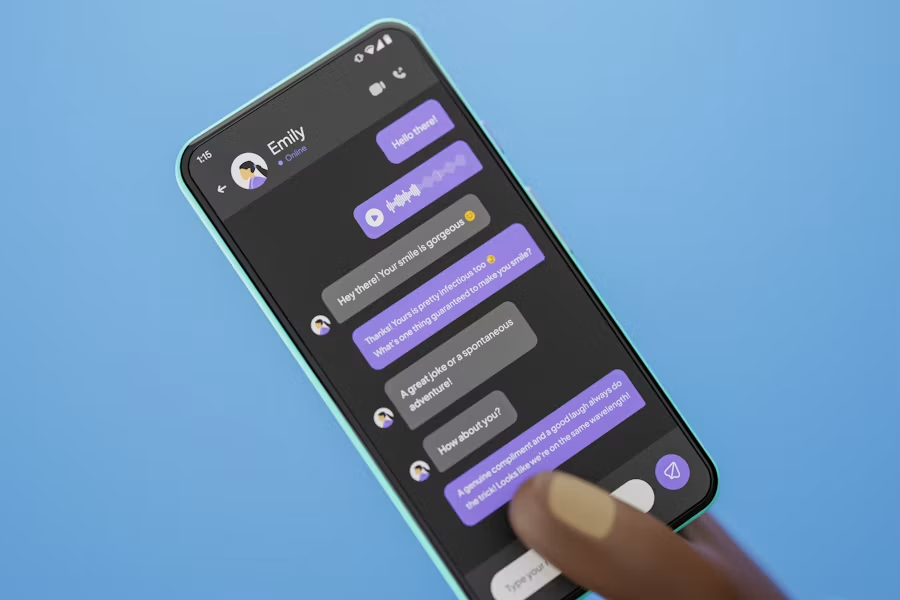
What Are Hinge Voice Notes, Exactly?
A voice note is an audio message inside a conversation. You have to match with someone first, then the microphone appears at the bottom of the chat. You record, listen back, delete it if you hate it, and send. Recipients can rewind, skip, or play it at half speed or double speed.
That is different from a Voice Prompt, which is an audio answer attached to your profile. It is public to anyone viewing you, whether you have matched or not; it runs up to thirty seconds, and you get one.
Both launched in late 2021, and the distinction matters more than it sounds. The Voice Prompt is the only Hinge feature where someone hears you before deciding. The voice note only exists after that decision has already been made.
So when people say Hinge is a voice dating app now, they are usually thinking of the prompt and describing the note.
Do Hinge Voice Notes Actually Work?
By Hinge’s own numbers, yes, and the numbers are worth reading carefully because they are all the company’s own.
At the 2021 Voice Prompts launch, Hinge reported that 65 percent of users believed hearing someone’s voice would help them determine interest in a match, and that 75 percent found it difficult to feel connected when limited to text and photos. It also said 52 percent felt they learned more about a match through a voice message than through text alone.
The one that matters most for voice notes specifically came later. Hinge data reported by CNBC found that sending a voice note in a conversation made it 48 percent more likely to lead to a date.
And the appetite has not faded. Hinge’s 2025 D.A.T.E. report, based on a survey of roughly 30,000 daters, found 35 percent of Gen Z want to receive more voice notes from the people they are talking to.
Two honest caveats. All of this is Hinge’s internal data and survey work, not independent research, and the company has an obvious interest in feature adoption. And there is a selection problem underneath the 48 percent: people who send voice notes are probably already more engaged than people who do not, so some of that lift is the person rather than the medium.
Even discounting for both, the direction is consistent, and it costs you nothing to test.
Related Article: Why Voice Intros Are Better Than Photos in Dating
What Is a Voice-First Dating App?
An app where the voice comes before the decision, not after it.
You hear someone’s introduction with their photograph still hidden. The only thing in front of you is whether you want to keep listening. If you do, the photo is revealed later, usually as a deliberate step rather than automatically.
Reev, SwoonMe and Vocalove are downloadable versions of this idea. Chat2Date has run a UK phone-based service since 2008. The best funded entrants, Overtone from Hinge’s own co-founder and Known, have not launched.
The important structural point is what gets removed. On a voice-first app there is no photo grid to browse, so the visual is not merely delayed, it is absent from the choosing entirely.

Hinge Voice Notes vs Voice-First Dating Apps: The Real Difference
It comes down to one thing: the order in which you receive information.
On Hinge, you see photographs, scroll a profile, possibly hear a thirty-second prompt, and decide. Everything after that, including every voice note, arrives once the visual judgement has already happened. Voice makes the conversation warmer. It does not change who you are having conversations with.
On a voice-first app, the visual judgement has not happened yet, so voice is doing the selecting rather than the decorating.
That is the entire distinction, and it explains why the two feel so different in practice despite using the same raw material. Hinge added audio to an existing decision. Voice-first products moved the decision.
Neither approach is obviously right. Hinge’s version is far easier to adopt and reaches vastly more people. The voice-first version is a bigger change and currently available to far fewer.
Which One Should You Use?
Almost certainly both, and if you can only do one thing this week, it is on Hinge.
Use Hinge if you want people to talk to. This is not a small point. A dating product’s usefulness is capped by how many people near you are on it, and small voice apps struggle badly outside major cities. Whatever you think of the format, Hinge has the pool.
Try a voice-first app if the thing exhausting you is the deciding rather than the outcome. If you have plenty of matches and no conversations, more matches will not fix it, and a product that changes how you choose might.
And be realistic about the friction. Recording an intro for a small app takes real effort and may reach very few people. Sending a voice note on Hinge takes fifteen seconds and reaches someone who has already matched with you.
Related Article: Voice Dating Apps in 2026: Who Is Actually Building One
How to Get More From Hinge Voice Notes Right Now
Since most people never send one, this is unusually easy ground to gain.
Send it early rather than saving it. A voice note three messages in changes the temperature of a conversation. One sent after two weeks of text feels like an escalation.
Keep it short. Hinge allows thirty seconds on prompts, and practitioners consistently find that much shorter performs better. Ten to fifteen seconds is plenty for a note.
Reply to something specific rather than introducing yourself. They already matched with you, so the job is not to sell yourself; it is to sound like a person responding to a thing they said.
Do not script it. Written sentences read aloud are audibly written, and it is the single most common reason a voice note lands badly.
And record it twice at most. The first take is stiff, the second is usually the one, and by the fifth you are performing.
Where CoreAllure Fits
CoreAllure is voice-first in the strict sense, which is worth explaining precisely because the Hinge comparison makes it clear.
There is no profile grid. You are introduced to one person at a time, and you hear their voice introduction with the photograph still private. The only decision in front of you is whether you want to keep listening. If you are curious, you choose Resonate, which is not a like and does not create a match; it simply continues the introduction. The reveal comes later, when you choose it.
Introductions are limited to five a day on Free and ten on Premium, which is the opposite of a feed. And once two people do choose to connect, there is a forty-eight-hour window to begin the conversation. If nothing meaningful begins, the connection closes gracefully, with no guilt and no penalty.
That last part is the thing Hinge’s voice features cannot address, because they sit inside a model where a match is permanent and free. Voice makes the conversation better. It does not do anything about the forty matches you never messaged.
CoreAllure has not launched and is currently waitlist-only, so if you want to use voice in dating today, Hinge is genuinely your best option.
The Bottom Line
Hinge voice notes and voice-first dating apps are answering different questions. Hinge asks how to make the conversation feel more human once you have found someone. Voice-first apps ask whether you found them the right way to begin with.
If you are already on Hinge, send the voice note. It is free, most people never do it, and Hinge’s own data says it makes a date meaningfully more likely.
And if the part that appeals to you is hearing someone before the photograph rather than after it, that is what CoreAllure is being built for, and the waitlist is where you say so.

Frequently Asked Questions
What is the difference between a Hinge voice note and a voice prompt?
A voice prompt is an audio answer on your profile, public to anyone viewing it, up to thirty seconds. A voice note is an audio message inside a chat, and you have to match with someone before you can send one.
Do Hinge voice notes get more dates?
Hinge reported that sending a voice note made a conversation 48 percent more likely to lead to a date. That is the company’s own data rather than independent research, and people who send them are probably more engaged to begin with.
Is Hinge a voice dating app?
No. Hinge is a photo-led app with voice features added. On a voice-first app, you hear someone before seeing them and before deciding, which changes who you talk to rather than how the conversation feels.
How long should a Hinge voice note be?
Short. Hinge allows thirty seconds on prompts, and ten to fifteen seconds is usually plenty for a note. Longer recordings start to sound like a monologue.
What are the best voice-first dating apps?
Reev, SwoonMe, and Vocalove are downloadable, and Chat2Date runs a UK phone service. Overtone and Known are the best funded but had not launched as of August 2026.
Should I use Hinge or a voice-first app?
Both, realistically. Hinge has far more users, which is the practical constraint that matters most. A voice-first app is worth trying if the problem is how you are choosing rather than how many options you have.
Related Topic: What are Voice Notes? – Hinge Help Centre
Related Topic: Hinge data shows this is the key to successfully landing a first date
Ready for a different kind of dating app?

How to Spot a Fake Dating Profile Before You Get Attached
Quick Answer: Knowing how to spot a fake dating profile in 2026 means looking beyond photographs and polished messages. AI-generated faces and convincing…

Dating as a Single Parent: How to Make Room for Someone New
Quick Answer:Dating as a single parent is mostly a time problem and an honesty problem, and almost none of the advice treats…

Dating After Divorce: Why Starting Again Feels Different
Quick Answer:Dating after divorce feels different because it genuinely is different, and not only emotionally. The mechanics changed while you were married.…
[…] Related Article: Hinge Voice Notes vs Voice-First Dating Apps […]